Wednesday, January 31, 2007

Deaf People and Eugenics

International History of Deaf People during World War II

Last April I visited the Holocaust Museum in Washington, DC where they had an exhibit on Eugenics before and during the Holocaust called Deadly Medicine . Here they described the contribution of doctors to Hitler's vision of the perfect race of people, including the sterilization of disabled people and development of methods of killing mentally ill and developmentally delayed people in mass numbers.

My awareness of Deaf people during the Holocaust developed when I met a Deaf woman from Germany. Her parents and sister were also Deaf. Her mother and sister had been sterilized as part of the cleansing of the German people. She, however, was only 9 or 10 years old at the time -- too young for the operation. When she grew up, she married a German Deaf man, emmigrated to America, gave birth to a Deaf daughter who also gave birth to a Deaf child. I've always thought that was a great story of how another person defeated Hitler.

But this is not an unusual story. Many Deaf children and adults were sterilized, some underwent forced abortions. Apparently, there was a myth that schools for the Deaf in Germany sheltered many children from these forced sterilizations, but relatively recent research has found that schools, rather than protect their children, often colluded with government officials. Biesold, Horst (1999) Crying hands : eugenics and deaf people in Nazi Germany Washington, D.C.: Gallaudet University Press. (And of course, Alexander Graham Bell was a strong force in eugenics here in the US, while he worked with deaf children.)

A recent book by Carol Padden and Tom Humphries, Inside Deaf Culture (HV2545 .P35 2005 at both Library West and the Education Library), discusses genetic testing and research with Deaf people. What does it mean when we can decide which disorders and diseases can be eliminated? What does it mean when groups of people should be eliminated, especially when they view themselves as a cultural group? What are weaknesses? What are differences?

But the website on Deaf people during WWII at the Rochester Institute of the Deaf not only includes videotapes of Deaf people from the US, Israel, and Germany describing their experiences during the Holocaust. Nope. It also includes rememberances of Deaf Japanese-Americans in Internment Camps in the US, and Japanese Deaf people in Nagasaki during the bombings. And artwork by Deaf artist and Holocaust survivor David Bloch. It is excellent!

Monday, January 29, 2007

Databases, Indexes, Print and Online

Recently 2 graduate students asked me if online databases would find print journals articles as well as electronic ones. And, they wanted to know, would they find articles that weren't in their own database. "Would Sociological Abstracts find journals that weren't full-text in Sociological Abstracts?" That was pretty ironic, since Sociological Abstracts actually contains no full-text journals.

"Huh?" you say. "I found an article that was online from SA just yesterday." Yeah. Sort of.

This explanation might bore you to tears (which is why we rarely tell anyone). On the other hand, it might clear up everything in the world for you.

Here's my beautiful diagram:
The first two boxes under the main database box show that some databases only index journals and articles, but don't have full text themselves. In our fields, these are the databases used most often, like LLBA, Sociological Abstracts, and PsycINFO.

You look through these databases for articles of interest. If you find one, our software, called SFX uses DOIs (digital object indicators -- links directly to articles) to find the ARTICLES we have access to through other databases. Sometimes articles don't have DOIs or our SFX database isn't up to date. Then you can follow the link to our catalog where wel list whether we have print copies of the journal or whether we subscribe to the e-journal for any period. (It doesn't tell you if we have the particular ARTICLE there.) If we have subscribe to some period of time (through any database), it will link to our database of e-journals and then to the database where the journal is. You need to look for the article there.

Other databases only contain full text journals -- most of these are publisher's databases or Open Access databases. In the Social Sciences you generally don't use these to look for articles. They are basically archives of journal articles. Generally, you use SFX or serial solutions to provide links between the indexing databases and the archiving databases.

But there are other databases. Like Academic Search Premier or Gale's OneFile. These have journals from lots of different publishers. The database indexes all kinds of articles, scholarly and popular, from all different fields -- science, social science and humanities. Some is full text, some are just citations.

So you can look up citations to full text or print in almost any index and find full text and print articles there. Link to them. Link to the library catalog. Pretty much just play around for as long as you'd like. I hope this made some sense and was a bit interesting to you...

Wednesday, January 17, 2007

African American Newspapers

The Historical Context of African American Newspapers: The 19th Century and The Chicago Defender

When Woodrow Wilson was mentioned in the Chicago Defender, it stated "President Woodrow Wilson (white) yesterday announced..." because that was how the African Americans of the time were cited in white-owned papers.

Last weekend I was watching TV (okay, so I watch a lot of TV while knitting and spinning) and I saw a fantastic program on PBS called The Black Press: Soldiers without Swords (Video #4678). Like much of what passes for entertainment on television today, it was fascinating. It delved into the blossoming of Black-owned newspapers all over the country after the Civil War when African Americans, especially in the South, were first allowed to read and write and used their literacy to keep abreast of what was happening in their world and also to actively change it.

When certain cities, again especially in the South, outlawed the distribution of the newspapers, Pullman Porters distributed them between towns by tossing bundles of them off trains. They said each purchased paper of the Chicago Defender was read by 4-5 people, since they were passed among friends.

More information, the entire transcript of the program, additional transcripts and videos of journalists, historians, and everyday folks talking about the importance of Black-owned newspapers are available free on PBS's website: The Black Press.

The UF libraries have electronic access to a database of African American Newspapers from the 19th century. We also have access to the Chicago Defender through the Black Studies Center.

In addition, if you search in our catalog under the subject "african american newspapers," you'll find 6 newspapers. However, if you look at that result list, you'll see that in many entries "african american newspapers" is followed by the name of a state in the U.S. Thus, we have a newspaper or newspapers from that state in microfilm. We probably have newspapers from at least 20-25 states. Often more than one from each state. (The following is just one page of the results list.)

Browse List: Subject Previous Page Next Page
No. of Recs Brief Recs Entry
3
African American newspapers -- Georgia
4
African American newspapers -- History
2
African American newspapers -- History -- 19th century
2
African American newspapers -- History -- 20th century
2
African American newspapers -- Indexes
1
African American newspapers -- Indiana
2
African American newspapers -- Michigan
3
African American newspapers -- Mississippi -- Bibliography -- Union lists
3
African American newspapers -- Mississippi -- Directories
1
African American newspapers -- Mississippi -- History

So we have maybe a hundred newspapers to wander through. And books on the history of those newspapers as well.

Go ahead and start with the online papers, but look at the papers from your own neighborhood. See if you can find your family and friends in there! You never know when you'll find a cousin, your grandmother, or the man you most admired in your life in a newspaper article!

Monday, January 08, 2007

Videos on the Internet

Which inspiring sociologist, psychologist, or linguist have you met in your backyard?

Max Weber Visits North Carolina -- Undergraduate Classes' Passion and Investigations

Today I was wandering around the Internet, looking for videos about these fields I love. I stumbled upon one made by the North Carolina Sociological Society about Professor Larry Keeter at Appalachian State University in North Carolina. (Before my stint here, I worked at a college near App State and lived a few miles down the road, so I do love Appalachia.)

Apparently early in Keeter's teaching career, students asked whether Max Weber had ever visited the United States and where. Quite a bit of research by him and the student led to the exciting information that Max Weber and his wife Marianne had visited relatives in North Carolina Appalachia. The students interviewed folks who were still alive and the rest became history.

This is a marvelous video of how inspiring study and history can become. Of course, it helps that some kind of miracle happens. Like that someone amazing, the figure from your field happened to land next door. Especially when you live in a neighborhood that is dismissed and denigrated by most of the other neighborhoods.

The video also discusses interesting historical info about how the folks viewed Weber right before WWI. Unfortunately, we don't have Keeter's article about the students investigation and oral history. Order it through InterLibrary Loan or let me know and I'll do it for you.

Keeter, Larry (spring-summer, 1981) Max Weber's Visit to North Carolina. The Journal of the History of Sociology, 3(2). 108-114.

Thursday, January 04, 2007

Stanley Milgram's Experiments

Milgram's Experiment "Replicated" on ABC's Primetime

Each semester students find out about the Milgram Experiments, sometimes from a psychology class, sometimes from their English/composition classes. As most everyone is, they are shocked, dismayed, horrified, to find out about the "banality of evil." To learn that under the guidance of an authority figure, everyday, normal people will administer electric shocks to innocents.

Primetime has a short video on its website that you can watch. However, in the video, they fail to state that the main difference they found between the participants who finished the experiment, giving the entire set of shocks, and those who refused, was...those who refused took personal responsiblity for their actions. The others were "doing their job" or "just following orders." (However, I'd like to see a real write up.)

But what really interested me was that at the time the Milgram Experiments were done in the 1960's, Milgram and the psychology world in general were aghast at the psychological pain that the experimental subjects endured. The APA held Milgram's application to the APA because of ethical concerns from his work. Human subjects restrictions were developed and tightened because of this work. Milgram and his colleagues were very careful to sit with subjects after the experiment and calm them after they found out the could act in such ways.

However, in the Primetime story, the reporter sat with the subjects and pointedly asked them how they could administer the shocks without considering the feelings or health of the "learner." As one of the other librarians said to me, he was torturing the torturer. Do we think that people have become so inured to torture, that we have to remind them when they engage in it? There wasn't an increase in the number of people finishing the experiment.

(Actually, in the study for Primetime, they shortened the experiment, so they didn't actually administer as "dangerous" a shock level. And 20% of Milgram's subjects stopped between the end of the Primetime experiment and his. So even though Primetime said that the results were similar, if another 20% stopped, then we'd get about 50.4% finishing, rather than 63%.)

The library has several resources about these experiments -- and also about the Zimbardo Prison Experiment. The program interviewed Philip Zimbardo and several of the "inmates" and "guards" who took part in the experiment, which Zimbardo calls one of the most unethical experiments ever run. (I assume he means in the United States. Not quite as bad as some in Nazi Germany, which were what these experiments were intended to study.)

Our resources include videos and DVDs, among them Quiet Rage: a DVD of the Stanford Prison Experiment. Zimbardo has an excellent website about the experiment as well. The Discovering Psychology series of videotapes includes a !9th tape which describes and excerpts the Milgram Experiment and the Prison Experiment.

The man who shocked the world : the life and legacy of Stanley Milgram by Thomas Blass was published in 2004. Thomas Blass is a psychologist who clearly greatly admires Milgram. (HM1031.M55 B57 2004)

American dreams and Nazi nightmares : early Holocaust consciousness and liberal America, 1957-1965, a book by Kirsten Fermaglich, describes how Jewish Americans, among them Stanley Milgram, took lessons from the Holocaust and applied them to the political situation in America after World War II. (LIBRARY WEST, Judaica Library 1st Floor - Northwest Corner D804.7.M67 F47 2006)

Understanding genocide: the social psychology of the Holocaust
edited by Leonard S. Newman and Ralph Erber is accessible online through netLibrary (logon remotely through VPN), We also have the book in print in the Judaica Library (the Northwest Corner of the 1st Floor in Library West). (D804.3 .S597 2002)

Classic experiments in psychology by Douglas Mook discusses the Milgram and the Unresponsive Bystander Experiments. (BF198.7 .M66 2004)

Experiments with people : revelations from social psychology edited by Robert P. Abelson, Kurt P. Frey, Aiden P. Gregg. includes Milgram's own discussion of his studies. (BF198.7 .M66 2004)

Tuesday, January 02, 2007

Invitation to Blog

What have you found to help you in the library? What is annoying?What is perplexing?

Would you write a short article in my blog about it? I wish to invite anyone from the University of Florida -- faculty, staff, graduate or undergraduate student -- to discuss the exciting, the perplexing and the annoying about the library here. Call (352-273-2649) or email merdavi@ufl.edu and I'll set you up so that you can write in the blog.

A great book? A fantastic encyclopedia? Got squashed in the compact shelving? Wish you could put on a musical in the library? (http://www.prangstgrup.com/librarymusical/) You might also wish to write something for a class you intend to teach later in the semester. Great idea!

Of course, you can always comment using the "comment" feature in the blog, but this way you'll be center stage.

Let me know. I'll be waiting. With my fingers crossed....

Thursday, December 14, 2006

Alerts from Databases

Alerts to New Publications from Your Favorite Databases and Journals

In Graduate School, I was wicked jealous of a post-doc's doctoral days at MIT. Her cognitive science librarian would send her newly published articles to stimulate my friend's scholarly curiosity. The librarian did this not only for my friend, but for the entire faculty and graduate student population of her department

Well, life has changed. The library faculty has shrunk and the number of our liaison departments has grown. At the same time, however, electronic databases and e-journals have stepped in to send you alerts every time a new article is published that you might like.

How does it work? Well, after you decide on the appropriate database and the best search terms, save a search, and then you can have the database run that search for you every so often (usually, you decide the time period). E-journals will usually run the search after each issue is published. In your email, you receive an update or alert about the new articles published after your last search.

So, if you are awaiting the article of your favorite author, you can save an author search. Have the database automatically run it and then email the results to you.

For an explicit example, check out the tutorial about setting up an alert in CSA databases like Sociological Abstracts, Social Services Abstracts or LLBA or the one about setting up an alert in EBSCO databases like PsycINFO, Academic Search Premiere, or GLBT Life Full Text.

Tuesday, December 12, 2006

Maps and Atlases

The World Atlas of Language Structures! A Book a Linguist would LOVE

One day last year, I went home to visit my parents. My father had a book in his hand; he was beaming. "Merrie," he said, "you have to see this book. It's by John MacDonald." Honestly, I don't remember the author's name nor the name of the book. "It's called 'The Historical Atlas of the World 1625-1895.' You have to read it. Every word is a gem!"

"Oh." I said, thrilled. Someone in the world had found out about historical atlases! It's something that I fear only librarians know about. But Barnes & Noble had put one on its remaindered shelf and my father had found it for $10. Excellent! "That's great. I always try to get students to read those. Atlases are wonderful. In them time and space are superimposed so that folks can see where and when history took place."

My Dad was persistent. It was that particular book that was special. "This John MacDonald. Every word is important. You have to read it. I'm going back to find more of them!"

Well, let me tell you all. We have a fantastic NEW atlas in. If you're a linguist, it's probably the most fun you may ever have with an atlas: The World Atlas of Language Structures (LIBRARY WEST: -- Reference (3rd Floor) -- P143 .W67 2005 [In-Library Use]

It'll take you ages to look through the whole thing. There are articles about the typology of languages -- what grammatical and phonological features occur in which languages. Then the languages are literally mapped out.

And for those of us interested in signed languages, there are even two maps of 21 signed languages -- they are mapped by negative incorporation and question particles. Very cool!

Sunday, December 03, 2006

Remote Logon

Logon from Home with the Virtual Private Network

Most of you know that you can access almost any of our databases or e-books from home. There are 2 different ways: the Library Proxy or the Virtual Private Network, each with a set of pros and cons. (You can link to them from the link in the upper right hand corner of most library pages -- in the blue stripe -- at the link "Remote Logon." But more about that later.)
Library ProxyVirtual Private Network (VPN)
Login each time you go to library pageDownload & install small piece of software to your computer
Must click on links to navigate through pagesThen, each time you return to the library website, open the software again and allow it to connect to the library proxy.
Using the back button or the address bar will knock you off the proxyCan navigate off library website and back on again
Can not link to databases from emails, WebCT, webpagesCan enter databases from other websites, email links, or software (EndNotes)


Basically, you have more freedom when using the Virtual Private Network and fewer concerns about being knocked off the proxy. Furthermore, it's actually more secure for the library. However, if you'll only use a particular computer once, you might still want to use the Library Proxy.

So here's the deal. Here's more information about the VPN -- at the upper, left-hand corner of the page. If you're convinced, download the VPN. You'll need your GatorLink ID and password. There are versions for Windows and MACs. Contact me with any questions you have. If I can't answer them, I'll find someone who can. And enjoy easy surfing through the library resources from home, Taiwan, or Iceland!

Wednesday, November 29, 2006

Tests & Measures in PsycINFO

Find Tests, Measures and Inventories in PsycINFO

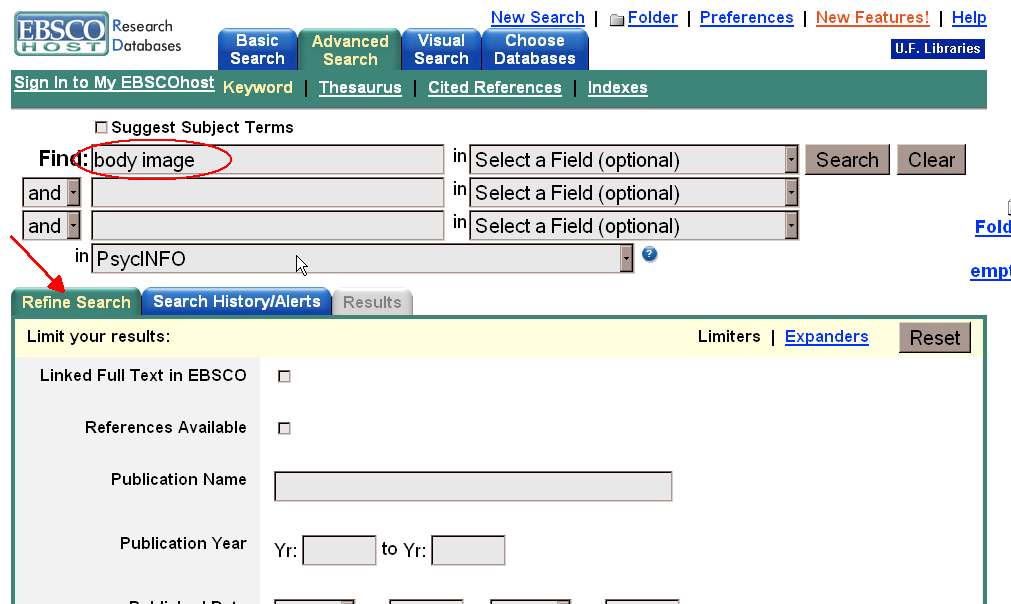
Another tip about finding Tests and Measures. When you get into PsycINFO, type in the domain of interest to you in the search box -- say, body image.
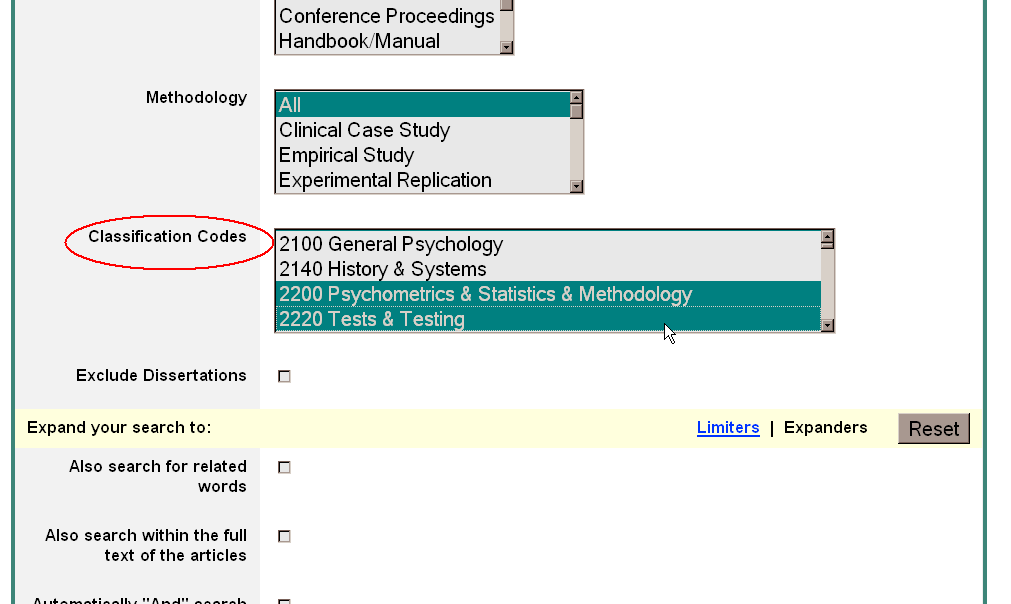
Then go to the Refine Search section below. Scroll down to the box "Classification Codes." Click on the selections

  • 2200 Psychometrics & Statistics & Methodology
  • 2220 Tests & Testing

(Use control from your keyboard and click with the mouse to click on both options.) This should bring up articles that have a strong focus on Tests and Measures in your field.

Here are the results from the Body Image search:
(Click on the picture to enlarge it.)
(I was thrilled to find out that this actually worked!)

Friday, November 10, 2006

ProQuest Black Studies Center!

The Schomburg Collection 74 Black Studies Journals The Chicago Defender in Full-Text (and even more)

We've had it for a few weeks. You might have checked it out already. If not, you're in for a great treat!

Faculty members, Graduate students, Undergraduates, Friends, Neighbors, Folks interested in fascinating stories. Do we have a database for you!

ProQuest's Black Studies Center includes one of the most comprehensive collections of the African Diaspora in the United States. Multidisciplinary essaies, an index of black studies journals, and over 1,000 full-text dissertations (yay!). It is lovely. It's just fun to play in, let alone do real work.

Before the digitalization, you would have to find a nice grant for a flight and hotel room, or a few dollars from your parents to hitch hike or ride in stinky bus stations and maybe sleep there so you could study. Then you'd have to find a blanket and sleep in the New York Public Library. But now you can stay in your own apartment, dorm, or friends' rooms in Gainesville and look up the material here in the library or on your computer at home.

The Schomburg Building at the NY Public Library is beautiful, but you probably don't want to sleep in the bus station too much. So use your computer, ours or your friends'.

You can perform a "quick search" by typing a few words in the upper left hand corner of the home page and then look at the the most interesting resources by format: essays, newspaper articles, journal articles, etc. The Black Studies center marks especially important, core articles that it considers "required reading" with a read star.

So have a good time looking through this amazing resource. You should find many different uses for it. Lots of material on language, socialization, psychology, mental health, life, love, where we are and where we've come from. Everything is here. It's a joy to have and I'm thrilled to pieces!

Friday, November 03, 2006

Reorganizing, Updating Subject Pages

What Resources do You Need? What would You Like to See?

When you glance at the subject guide pages for Psychology and Sociology, especially, can you guess where to go to start a search? To begin working on a paper? To get help? Doubt it. Your eyes glaze over. They're too crowded. It's like a dictionary where you have to know how to spell the word before you can get the spelling.

You have to know which database to use, before you can find the database to use.

So, I'm going to reorganize and update the subject pages.
The plan? I'm going to have separate pages for some of the specialities, like Aging and Counseling. A page for Tests and Measurements. One for Statistics. That way I can put lots of stuff on there for you to find on those topics. Also guides or suggestions on which databases to use for what.

But what would you like to see? I'd love to know -- from everyone -- faculty, graduate students, undergraduates, and librarians. Thanks.

Sunday, October 29, 2006

Tests and Measures in the Social Sciences


Looking for Tests, Measures, and Inventories in the Library? Here's an Index

Every week someone e-mails me wanting tests and inventories hoping to measure everything from anxiety to the quality of the relationship between people who work together.

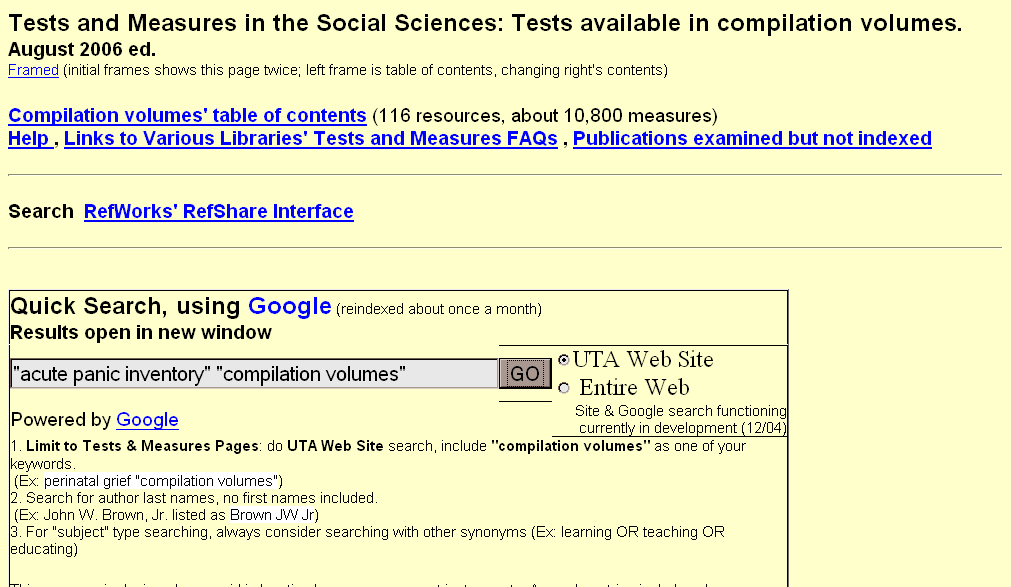
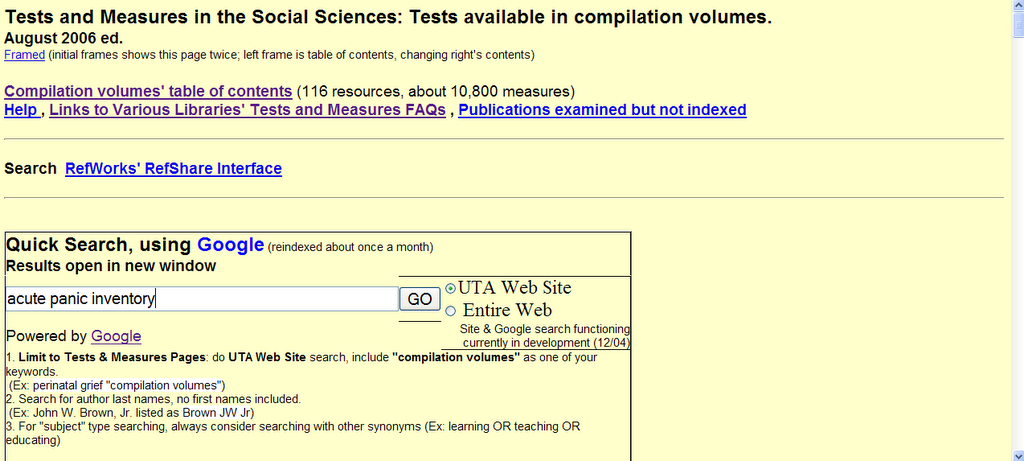
A wonderful librarian, named Helen Hough, at Central Library at the University of Texas at Arlington indexed over 100 compilations that include tests, measures and inventories. It's set up as a live database, so you can type in the name (or subject) of the test you're interested in, and you'll get a list of results. Click on the one that looks most promising. Not only will you get a citation of the book, you'll also be told how much of the test is included.

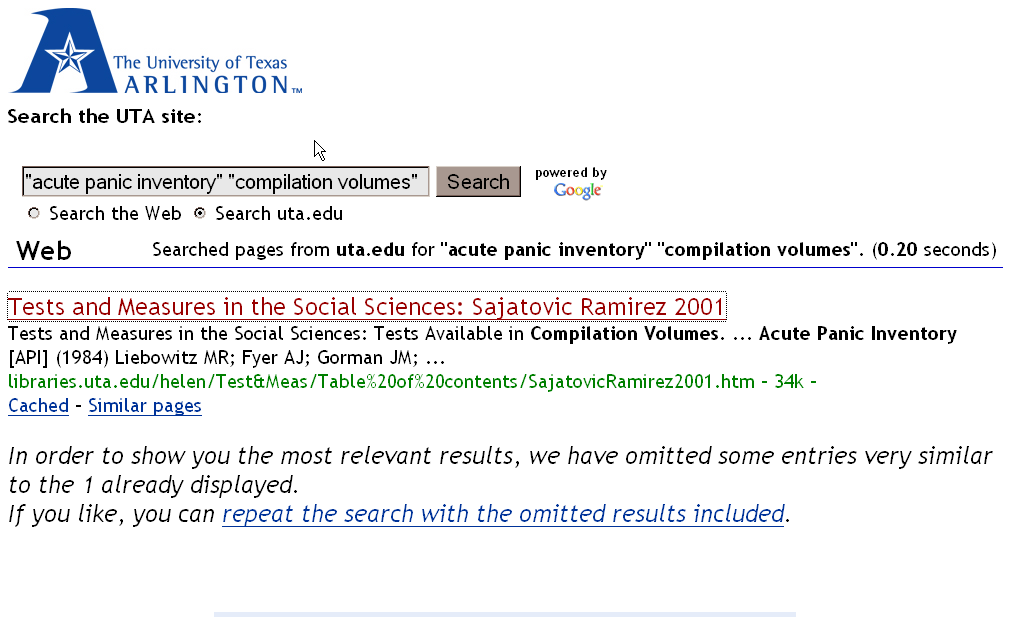
So, for instance, if you're looking for the Acute Panic Inventory, type it in, plus "compilation volumes" as above. Then get Google results: (Click on the pictures to enlarge them.)

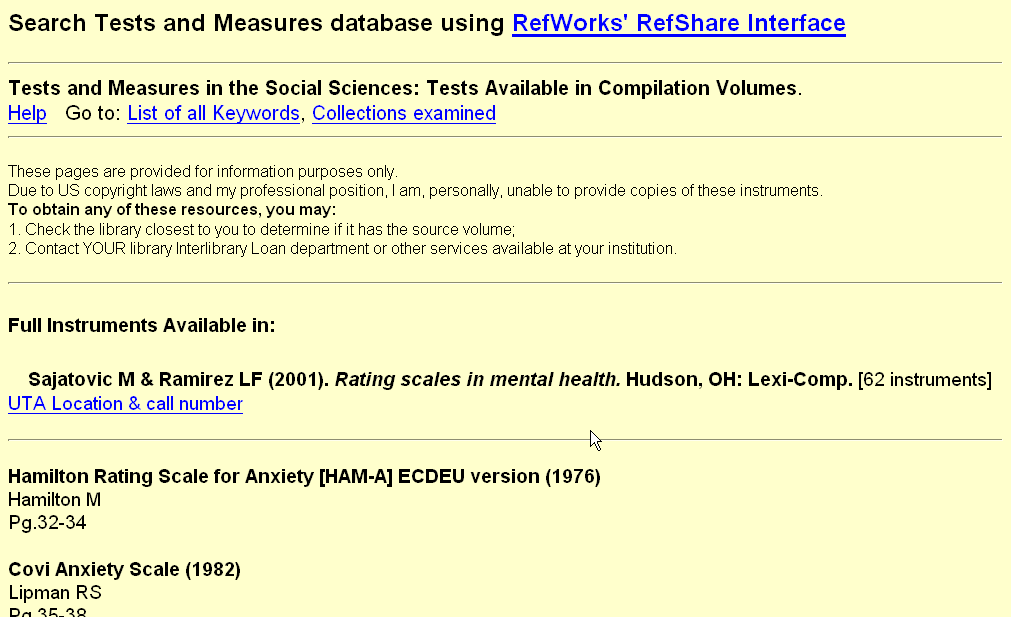
In this case, click on the link -- it's for the Acute Panic Inventory. And this is the result you'll get. It says that the entire test is included. And also lists all of the other tests included in the book.
Sajatovic M & Ramirez LF (2001). Rating scales in mental health. Hudson, OH: Lexi-Comp. [62 instruments] UTA Location & call number (There's a link to look up the book in their library. It's nice for them, but not so helpful for us :-( If we don't have it, just ask to borrow it through ILL.

So just look up the book in our library catalog to see if we have it. In this case, it's at the Health Center Science Library (the Medical School Library) and can be checked out. Pretty cool! Made me happy when I found it.

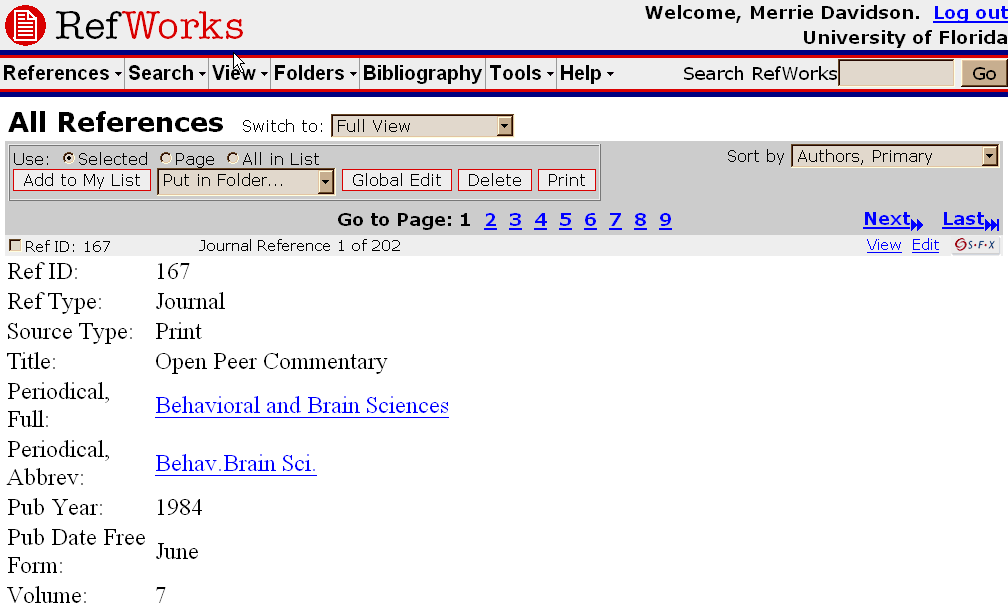
[I'm delighted to add that Ms. Hough commented that there is "a lot more stuff in Refshare." That's the link above the Quick Search box. In that database she and her colleagues use RefWorks to gift us with even more information about the locations of tests and measures. When you get into Refshare, you can search for what you'd like by using the dropdown list under Search on the very left-most bit of the menu at the top of the page. (Choose Advanced -- That gives you the most options.) Again, enjoy yourselves!]

I mention the details about Ms. Hough because she has performed such a service to all of us. Thank you Ms. Hough. Thank you so much. You have already helped two of the librarians at the University of Florida within 2 days of finding out about your index. We grovel in thankfulness.

Thursday, October 26, 2006

Journals in Print

Yes. Some Journal Articles are Only Available in Print. Still.

Some journals have yet to go online. Others haven't put their older files (backfiles in librarian lingo) online. In other cases, we've decided that buying duplicate sets in electronic format is an unwise use of our funds. Therefore, expect to need to look for some journals in print.

Recently, many students have asked me how to look for journal articles in print. Here is a lovely tutorial. Remember you have to search for the title of the journal, not the article in the library catalog.

Saturday, October 21, 2006

Poetry Readings? Meetings? Public Space?


Starbucks Opens Monday! Let's Use the Library as a Community Space


For many of us, caffeine activates our minds and keeps our bodies awake for longer and deeper study. Plus it's tastier than ever. And the aroma! Just delightful! Cookies, pretzels, and music seduce us into Starbucks on the first floor of Library West.

Bring your covered drinks into the other areas of the library, but eat the foods down on the first floor -- below the escalator.

What do we want to do with those spaces? Poetry readings? Jazz clubs on Friday evenings? Meeting space for clubs? Other academic libraries in Universities and Colleges use their library cafe's as public community space.

http://wally.rit.edu/javawally/

If you have ideas, want to develop weekly or monthly meetings, let me know. See what we can dream up. And have a great time!

Wednesday, October 11, 2006

Using Google, Using the Web

Harvard's Guide to Using Google for Research

In a previous entry, I mentioned Google Scholar, but I failed to mention Google in general. As Harvard University's library states in its wonderful guide to using Google for research, the web hosts many useful resources for academic purposes, especially to find statistics and demographics. Authoritative labor, criminal justice, child abuse, and mental health statistics are all available from governmental and NGO websites.

However, it's important to sift through information and websites carefully. That's where Harvard University's guide is especially helpful.

Our library also suggest Internet Resources. And each Subject Guide includes internet resources, as well.

Sunday, October 08, 2006

Subject Specific Encyclopedias

Finding a Topic? Narrowing a Topic? Need Info in a New Area? Look in an Encyclopedia

When you think of encyclopedias or dictionaries, you probably think of World Book, Britannica, or Websters. But we have encyclopedias, dictionaries, and handbooks that focus on particular topics, with articles by eminent scholars, overviews, providing background to almost anything you need to know about. The reference citations lead you to core articles and conversations between scholars and researchers.

We have many encyclopedias online through the Gale Virtual Reference Library. You can search for topics through all of the articles in all of the encyclopedia we have online at the same time. Or you can browse through them individually by linking to them through the Library Catalog.
The Encyclopedia of Children and Childhood is one of my favorites.

We also have access to the Encyclopedia of Psychology published by the American Psychological Association. (It is browseable by volume only, so the link above only goes to the first volume.) In the next couple of months, we will buy the Encyclopedia of Sociology published by Blackwell and edited by George Ritzer.

Wednesday, September 27, 2006

Sage Journals

Free Online Access to All Sage Journals Until October 18th, 2006


Sage Publications is trying to entice us to subscribe to more of their journals directly from them. We already subscribe to a very large number. Some we get directly from them, others through other vendors like Wilson Web or EBSCOhost. But, hey, why not take advantage of their offer by reading as many articles as possible between now and October 18th.

Go to their website and browse through their journals. If there is a journal you think we can't live without, please let me know. (You might want to check our catalog first. We really do subscribe to a large percentage of their journals.) You may discover hidden journals we have that few people use! One of my goals is to get folks to use our resources. If books lie around on shelves or e-journals float in the ether, the University is tossing your tuition and tax money away.

RefWorks

Download Citations Even from Google Scholar!


I tell you, some days libraries, the Internet, computers, software, and research just gets so exciting, I don't know how we can manage not to smile from ear to ear every minute. (Oh. Right. We read what the research says. Oops.)

Anyway, the library subscribes to RefWorks, citation management software that is online. Faculty, staff, and students can use it to keep records of books, journals articles, webpages, videos/DVDs, and just about anything else we use for research. Because the records are online, you don't need to worry about your harddrive getting corrupted, your laptop being stolen, or your card file catching on fire.

RefWorks has tutorials to help you set up your work. You can use RefWorks to organize your reading (and writing) in different folders, print out Works Cited pages in hundreds of bibliographic styles, and download searches directly from databases. It's downright amazing.

And now, you can download searches, or at least individual citations, directly from Google Scholar. Keffer Library at the University of St. Thomas has a very nice tutorial that shows you how to set your preferences in Google Scholar so you can download to RefWorks. (You can also download into other Citation Management software like EndNotes or ProCite, if you use those.)

By the way, Google Scholar searches scholarly journals and links directly to full text articles. It's quite nice. One drawback...We don't know which journals it searches. It does NOT search ALL of our journals. And many of the journals it searches we do NOT subscribe to. But we do have SFX linking, so you can see which we subscribe to electronically and which we have print subscriptions to. Use it. You'll like it!

Tuesday, September 26, 2006

Oxford African American Studies Center

Online Reference Books, Primary Sources, Biographies, Essays, and Special Features

I'm thrilled to announce that the UF Libraries now have access to the Oxford African American Studies Center, an online multidiscliplinary reference database edited by Henry Louis Gates, Jr. of Harvard University.

Wander through the database. You can find biographies, primary sources, information about music and art, life and culture, history, business, just about anything. It's especially good for finding topics for papers and getting started with good background information for papers and presentations.

For example, browsing through the maps, I found a map of "Post-War Black Schools," along with a description of the Freedman's Bureau and its relationship to education. A list of related links (within the database) would led me to the following articles
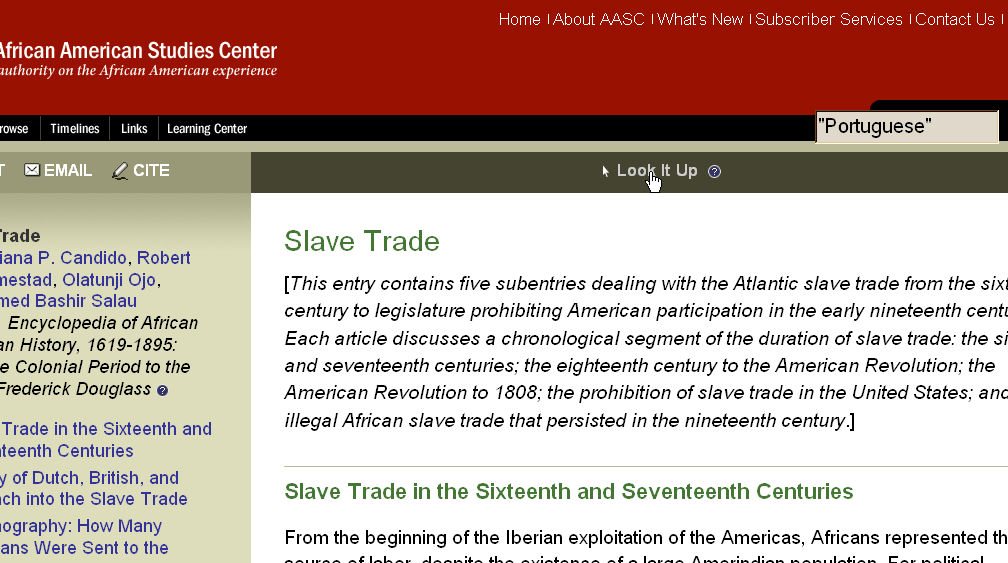
Navigation is easy and fluid. A timeline guides the user through all aspects of the African Diaspora at once or specific aspects of it, including links to articles in the database. You can highlight any word or phrase in an article, click on "Look it up" at the top of the page. The phrase will move into the search box and it will be automatically searched.


Under "Links" on the black stripe at the top of the page, are excellent links to websites on other topics: dance in Africa and the African Diaspora, Black women writers, the Greensboro sit-ins, African Americans in the military, among others.

You can print out or email articles to yourself.

As usual, let me know what you think about this database -- positive and negative. If you're having problems finding something you feel must be in it, but is elusive, we might be able to find it together. There's another similar (but even more exciting) database in our near future. So keep your eyes here!